
Anti-Angiogenic Targeted Therapy in Dehradun
Anti-Angiogenic Targeted Therapy in Dehradun
Anti-angiogenic therapy is a type of targeted cancer treatment designed to stop the growth of new blood vessels that tumors need to grow and spread. Tumors require a continuous blood supply to receive oxygen and nutrients. Anti-angiogenic medications block the formation of these blood vessels, a process known as angiogenesis.
By preventing the development of new blood vessels, this therapy can slow down tumor growth and help control the spread of cancer. Anti-angiogenic therapy is commonly used in the treatment of ovarian cancer and other gynecologic cancers as part of a comprehensive cancer treatment plan.
Conditions Treated with Laparoscopic Surgery
Laparoscopic surgery is a minimally invasive technique used to diagnose and treat several gynecologic conditions with smaller incisions and faster recovery.
Early-Stage Gynecologic Cancers
Minimally invasive surgery used for selected early-stage cancers of the reproductive organs.
Ovarian Cysts & Tumors
Laparoscopic removal of ovarian cysts or benign ovarian tumors.
Endometrial Cancer
Used for staging and surgical treatment of early-stage endometrial cancer.
Cervical Cancer
Minimally invasive surgical techniques may be used for selected cervical cancer cases.
Pelvic Masses & Tumors
Evaluation and removal of abnormal pelvic growths and tumors.
Endometriosis
Laparoscopy helps diagnose and treat endometriosis by removing abnormal tissue.
Uterine Fibroids
Fibroids can be removed using minimally invasive laparoscopic techniques.
Benefits of Laparoscopic Surgery
Laparoscopic surgery is a minimally invasive technique that provides several advantages compared to traditional open surgery.
Because of these benefits, laparoscopic surgery is widely preferred for many gynecologic procedures whenever possible.
How Laparoscopic Surgery is Performed
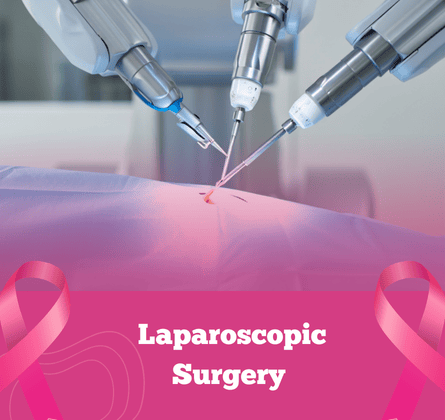
Laparoscopic surgery is a minimally invasive procedure performed using a small camera and specialized instruments through tiny incisions.
Small Incisions
Small incisions are made in the abdomen to allow access for the laparoscope and surgical instruments.
Laparoscope Insertion
A laparoscope (small camera) is inserted through one incision to provide a clear view of internal organs.
Surgical Instruments
Specialized surgical instruments are inserted through other small incisions to perform the procedure.
Monitor Guidance
The surgeon performs the surgery while viewing the organs on a high-resolution monitor.
Closure of Incisions
After the procedure, the instruments are removed and the small incisions are carefully closed.
Recovery After Laparoscopic Surgery
Recovery from laparoscopic surgery is generally faster compared to traditional open surgery due to smaller incisions and minimally invasive techniques.
Doctors provide post-operative care instructions to ensure smooth healing and a safe recovery.
Why Choose Laparoscopic Surgery?
Choosing laparoscopic surgery provides several advantages compared to traditional open surgical procedures.
Minimally invasive laparoscopic techniques help patients recover faster and return to normal life sooner.

Laparoscopic Surgery – Frequently Asked Questions
Find answers to common questions about laparoscopic surgery, a minimally invasive technique used for diagnosing and treating gynecologic conditions and cancers in Dehradun.
Laparoscopic surgery is a minimally invasive surgical technique that uses small incisions and a thin camera called a laparoscope to perform procedures inside the abdomen or pelvis. It allows surgeons to treat various gynecologic conditions with greater precision and less trauma compared to traditional open surgery.
Laparoscopic surgery can be used to treat various gynecologic conditions including ovarian cysts, endometriosis, uterine fibroids, pelvic masses, and certain gynecologic cancers such as ovarian and endometrial cancer.
Laparoscopic surgery offers several benefits such as smaller incisions, less postoperative pain, minimal scarring, reduced blood loss, shorter hospital stay, and faster recovery compared to traditional open surgery.
Recovery after laparoscopic surgery is usually faster than open surgery. Many patients can return to normal activities within a few days to a couple of weeks, depending on the type of procedure performed.
Dr. Yamini Kansal is an AIIMS-trained Gynaecological Oncologist specializing in advanced laparoscopic gynecologic cancer surgery. She provides minimally invasive surgical treatments and personalized care for women in Dehradun.